

Why Does My Hip Hurt When I Walk? Common Causes and What to Do
Walking is great exercise, and a great part of a healthy lifestyle. It’s something our bodies were built to do, and it should be a relaxing and invigorating experience, not painful. Unfortunately, for some people walking can be a source of hip pain. It can be a slow ache that arises after several minutes walking, or it can be at its worst in the first few steps after standing from a chair. It can even be a sharp pain that accompanies every step.
Hip pain while walking can take many forms and have many causes. It can come from the hip joint itself, the muscles and tendons surrounding it, or even another area such as the lower back. Where and when you feel the pain can provide some useful clues about what may be causing it.
Why Walking Can Bring Out Hip Pain
While walking is completely natural and something our bodies were designed to do, it does require quite a bit from our hips. Walking forces our hips to support our body weight while moving our legs forward and backward, stabilizing the pelvis, and coordinating with the muscles of other body parts like the trunk and legs. The hip is one of the largest joints in the body, and it is working constantly to move and provide support and balance1.
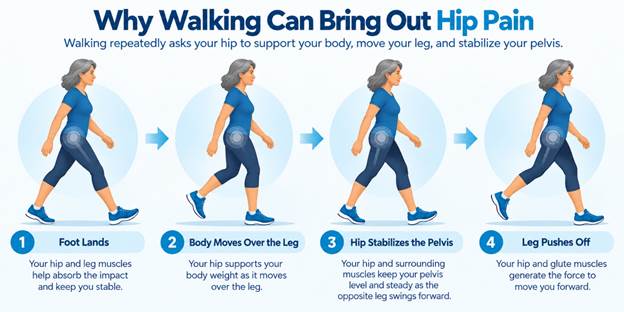
Because walking requires so much of your hips and involves so many different body parts, there are many opportunities for something to get irritated, inflamed, or fatigued. When this happens, it can lead to pain in your hip. When and where you feel this pain may help you understand what’s causing it.
What Does the Timing of Your Hip Pain Tell You?
While it may not be obvious, being aware of when you feel hip pain and how it changes over time can provide some helpful clues. Some common questions about the timing of hip pain include:
Why does my hip hurt when I first start walking?
Some stiffness after a period of inactivity can be common, but some people experience their worst hip pain after sitting or sleeping. This can be especially true if you suffer from a condition like osteoarthritis2.
Why does my hip start hurting after I've walked for a while?
As mentioned above, walking requires a lot from your hips. If you find that pain emerges after 10, 20, or 30 minutes of walking, the timing may provide useful information about how much activity your hips can tolerate. This is something to mention during an evaluation.
Why does my hip hurt after walking but not during it?
Sometimes symptoms appear after accumulated activity instead of during it. If you find that pain regularly follows a particular activity, this may be helpful information to provide if you get a medical evaluation.
Why does my hip hurt more on stairs or hills?
Climbing and descending stairs and inclines naturally puts a different kind of stress on your hips with a different level of intensity. Some hip problems may become more noticeable during these activities.
What Does the Location of Your Hip Pain Tell You?
The location of your hip pain can be very helpful to a medical provider trying to evaluate the underlying cause. While the timing and location of your pain should not make you feel like you can diagnose yourself, recognizing these things can help you make small lifestyle adjustments to avoid or overcome hip pain in the future, and they can definitely provide useful information to a medical professional evaluating your pain. Some of the more common locations include:
Pain in the groin or front of the hip
Pain felt deep in the groin or the inside/front of the hip is more commonly associated with structures within the hip joint rather than in surrounding soft tissues. Some causes can include hip injury, labral problems, or arthritic conditions, among many others3.
Pain on the outside of the hip
Pain on the outside of the hip, or lateral hip pain, is a situation where softer tissues like tendons, muscles, and bursae become more relevant. This type of pain is often experienced while walking or climbing stairs, but is also often associated with pain felt after laying on one side or the other.
Pain that travels down the leg
This type of pain, especially when accompanied by tingling, numbness, burning, or shooting sensations, may indicate a nerve problem rather than the hip joint itself.
None of this information should make you feel like you can accurately diagnose your specific condition, but all of it should be provided to your physician or physical therapist when they are evaluating you.
The truth is that there are many potential causes of hip pain. Degenerative conditions like arthritis can contribute to hip pain. Muscle weakness or poor hip stability can sometimes contribute to movement problems and place extra demand on surrounding tissues. Also, tendon irritation, bursitis and other soft-tissue irritation, muscle strains, overuse, and referred pain from the lower back can all be potential sources of hip pain.
What Can You Do About Hip Pain from Walking?
If you find yourself experiencing hip pain, there are a few things you can do before reaching out to a medical professional (assuming it’s not an emergency situation, like after a significant trauma). First, pay attention to the pain. Notice where it hurts and when. How long does it last? What makes it better? What makes it worse? Is there stiffness, numbness, tingling, or weakness?
It can also be a good idea to temporarily modify any activities that may be aggravating the pain. If walking causes pain, consider adjusting the duration, frequency, and/or intensity of your walks. This doesn’t mean to stop moving altogether. Depending on the cause and severity of your symptoms, gentle, comfortable movement may be more appropriate than total rest and immobility.
Also, don’t just assume that stretching is the best remedy. Flexibility and mobility may very well be a problem, but it may be strength that you need. It may be a matter of load management. Sometimes the source of the pain isn’t the hip at all. This is why a proper evaluation can be invaluable.’
When Should You Get Hip Pain Checked Out?
Most hip pain can be resolved with basic treatment, but in some cases prompt medical attention is required. You should seek emergency care if you experience severe hip pain after a fall or injury, are unable to walk or put weight on the leg, have a swollen hip that feels hot, notice color changes around the hip, or have pain that is accompanied by a fever5.
In other cases, you should consider making an appointment for an evaluation if:
- the pain keeps returning,
- it's getting worse,
- it's limiting how far you can walk,
- you're beginning to limp,
- stairs or standing from a chair are becoming difficult,
- you've reduced normal activities because of it,
- home management hasn't helped.
Contacting a local physical therapist is a great way to get a professional evaluation that will seek out the underlying cause of your pain rather than simply treating the symptoms. A qualified PT will evaluate your pain, mobility, strength, and flexibility with an eye toward developing a personalized treatment plan based on your specific symptoms, needs, and abilities.
If hip pain is impeding your ability to walk or perform normal daily tasks, reach out today to schedule an evaluation. The sooner you address the issue, the sooner you will be on a path to moving and feeling better and living the life you deserve.
Sources
- “Hip Pain: Causes, Common Conditions & Treatment.” Cleveland Clinic, 5 June 2023, https://my.clevelandclinic.org/health/symptoms/21118-hip-pain.
- “Osteoarthritis of the Hip.” NHS Inform, 16 Oct. 2024, https://www.nhsinform.scot/illnesses-and-conditions/muscle-bone-and-joints/leg-and-foot-problems-and-conditions/osteoarthritis-of-the-hip/.
- “Hip Pain Causes.” Mayo Clinic, 2019, https://www.mayoclinic.org/symptoms/hip-pain/basics/causes/sym-20050684.
- Hospital for Special Surgery. “Hip Pain Causes, Conditions and Treatments.” Hospital for Special Surgery, 3 Jan. 2025, https://www.hss.edu/health-library/conditions-and-treatments/list/hip-pain-causes#labral.
- Austwick, Megan. “Signs Someone Should Speak With a Doctor About Hip Pain.” Medicalnewstoday.Com, Medical News Today, 29 Oct. 2024, https://www.medicalnewstoday.com/articles/when-to-see-a-dr-for-hip-pain.