

Why Does My Hand Go Numb? Common Causes of Hand and Finger Numbness
Numbness in your hands or fingers can be very unsettling. If you wake up with your hand feeling “asleep” because you slept awkwardly last night, that’s easy enough to understand. Sometimes, though, the cause of numbness is much less obvious and may be more concerning.
You may feel some tingling while driving or find that certain fingers repeatedly go numb while you’re working. While the sensation itself may be easy to overcome, it can be hard to shake the sense that something must be wrong. Fortunately, most hand numbness is not a sign of brain or spinal cord problems that could be linked to dangerous conditions like strokes or tumors. It more often indicates compression, damage, or irritation in a nerve or nerve branch in your hand or wrist1.
Sometimes the numbness is a temporary condition related to positioning, but sometimes the numbness is persistent or recurring. In these cases, the way the numbness feels can be informative. Is it a simple feeling of reduced sensation, a tingling or “pins and needles” feeling, a burning sensation, or maybe even an electrical sensation?
The location of the numbness matters as well. Different nerves serve different areas of the hand, so which parts of the hand and fingers are involved in the sensation can sometimes shed light on where the problem is coming from.
With that in mind, let’s consider some of the more common causes of hand and finger numbness.
Carpal Tunnel Syndrome
This may be one of the first things that comes to mind when your hand or fingers go numb. It’s a well-known condition often associated with these symptoms. Carpal tunnel syndrome is the result of the median nerve becoming compressed as it passes through the carpal tunnel at the wrist. It can feel like numbness, tingling, pain, or weakness, and is typically experienced in the thumb, index finger, middle finger, and sometimes part of the ring finger2.
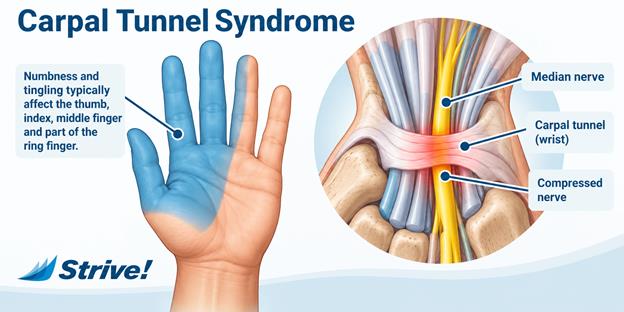
Symptoms may be more noticeable at night or during activities that involve prolonged or repetitive wrist positioning. Often, carpal tunnel syndrome sufferers may find themselves shaking their hand to relieve the sensation.
Cubital Tunnel Syndrome / Ulnar Nerve Compression
This is a less well-known cause of hand or finger numbness and typically has a very different numbness pattern. Cubital tunnel syndrome involves compression of the ulnar nerve as it passes through the cubital tunnel behind the inside of your elbow, the area you may know as your “funny bone”. Unlike with carpal tunnel syndrome, symptoms may include numbness and tingling along the inner forearm and into your ring and pinky fingers, especially when your elbow is bent3.
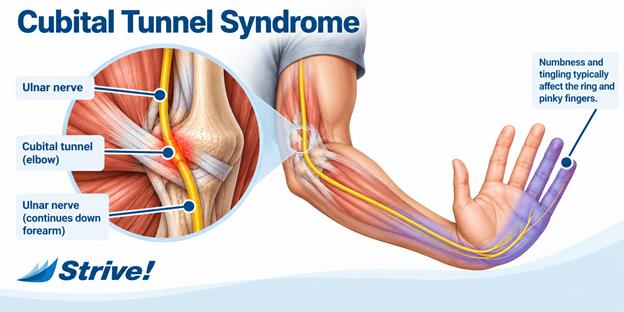
The sensation caused by the ulnar nerve being pressed against bone is where the name “funny bone” comes from. The location is why symptoms of cubital tunnel syndrome are frequently experienced while holding a phone, driving, or resting your elbow on a desk.
A Pinched Nerve in Your Neck
While hand and finger numbness often originates in nerves of the hand and arm, it’s important to keep in mind that the body is a complex network of interacting systems, and symptoms can sometimes be felt in places far from the source. Nerves serving your hand and arm originate in the cervical spine (neck). An irritated or compressed cervical nerve root can cause symptoms that travel through the shoulder and arm and into the hand. The pain and numbness associated with cervical radiculopathy (a pinched or compressed spinal nerve root) can sometimes even resemble other conditions like carpal tunnel syndrome4.
Depending on which cervical nerve roots are involved, the symptoms may be felt in different places. You may feel it on the thumb side of your hand, around your middle finger, or on the pinky side of your hand. In some cases, symptoms may be associated with neck or shoulder pain and may feel like burning or electrical sensations.
Peripheral Neuropathy
Sometimes nerve problems extend beyond simple mechanical compression. Peripheral neuropathy is a general term for nerve damage that occurs outside of your brain and spinal cord. Because neuropathy can affect multiple nerves, symptoms may be more widespread or occur on both sides of the body. The most common cause of peripheral neuropathy is diabetes, and while diabetic peripheral neuropathy most commonly begins in the feet, it can affect the hands as well5.
Temporary Nerve Compression from Positioning
This is the fairly common, relatively benign cause of hand and finger numbness most people experience. Keeping your arm or wrist in one position for a prolonged period can temporarily place pressure on a nerve. This is the experience most people describe when they talk about a hand “falling asleep”. This sensation can follow sleeping with your arm under your body, keeping your elbow bent for too long, or leaning against your elbow or forearm for an extended period.
This type of temporary numbness will typically go away shortly after changing positions. Most people have experienced a period of temporary numbness followed by sensation returning shortly thereafter. This is a different experience than numbness that repeatedly returns, persists, spreads, or occurs without an obvious trigger.
Other Possible Causes of Hand Numbness
The conditions listed above are far from being the only possible causes of hand of finger numbness. This is why persistent or recurring numbness should be evaluated by a medical professional. Several other possible causes can include:
- Vitamin B12 deficiency
- Thyroid disorders
- Raynaud's disease
- Multiple sclerosis
- Certain medications, including some chemotherapy drugs
- Injuries affecting nerves in the arm or hand
- Ganglion cysts or other structures placing pressure on a nerve
- Circulatory problems
- Less commonly, conditions affecting the brain or spinal cord
Again, the human body is a complex collection of interconnected systems, and it’s not always obvious what may be contributing to one symptom or another. Reading online articles (like this one) is not a substitute for a professional medical evaluation.
In some cases, hand numbness may be an emergency. Seek emergency medical care if you experience sudden hand or arm numbness accompanied by symptoms such as:
- Weakness or paralysis
- Difficulty speaking
- Confusion
- Dizziness
- A sudden severe headache
Finding the Source of Your Hand Numbness
While the timing and location of symptoms can provide useful clues, determining the actual cause of persistent or recurring numbness will often require a medical evaluation. A medical professional can help determine where along the nerve pathway the problem originates and what can be done about it. A clinician may consider:
- Which fingers are affected
- Whether symptoms affect one or both hands
- Whether symptoms extend into the forearm or arm
- Neck, shoulder, elbow, or wrist symptoms
- Positions or activities that trigger the numbness
- Strength or grip changes
- How long symptoms last
- Whether symptoms are becoming more frequent
If you or a loved one is experiencing persistent or recurring hand numbness, consider scheduling an appointment with your doctor or a local physical therapist. The sooner you get an accurate diagnosis and an effective treatment plan, the sooner you will be able to overcome your symptoms and leave your hand or finger numbness in the past.
Sources
- Mayo Clinic Staff. “Numbness in Hands Causes.” Mayo Clinic, 21 July 2025, www.mayoclinic.org/symptoms/numbness-in-hands/basics/causes/sym-20050842. Accessed 6 Oct. 2026.
- “Carpal Tunnel Syndrome.” Medical educational guide. American Academy of Orthopaedic Surgeons, 2018, www.orthoinfo.org/globalassets/pdfs/carpel-tunnel-syndrome.pdf. Accessed 6 Oct. 2026.
- Bise, Christopher. “Guide | Physical Therapy Guide to Cubital Tunnel Syndrome.” Choose PT, 26 Aug. 2021, www.choosept.com/guide/physical-therapy-guide-cubital-tunnel-syndrome. Accessed 6 Oct. 2026.
- Jajeh, Hamzeh, et al. “A Clinical Review of Hand Manifestations of Cervical Myelopathy, Cervical Radiculopathy, Radial, Ulnar, and Median Nerve Neuropathies.” Journal of Spine Surgery, vol. 10, no. 1, Mar. 2024, pp. 120–34, https://doi.org/10.21037/jss-23-39. Accessed 6 Oct. 2026.
- Cleveland Clinic. “Peripheral Neuropathy: What It Is, Symptoms & Treatment.” Cleveland Clinic, 14 Oct. 2022, my.clevelandclinic.org/health/diseases/14737-peripheral-neuropathy. Accessed 6 Oct. 2026.