

Why Does My Back Hurt When I Stand Too Long?
Back pain can come from seemingly nowhere. It can happen after a day of standing at work or after cooking a large meal or waiting in a long line, even if you didn’t lift anything heavy or bend awkwardly. It’s as if standing itself is a problem, like your back struggles just to support its own weight.
Unfortunately, this sort of sudden back pain without an obvious cause is something many of us have had to deal with. And it seems to get more common as we age. The truth is that our bodies were built to move, and standing in one position – even if it started as a comfortable position – can fatigue supporting muscles and aggravate sensitive tissues, maybe even aggravating an underlying problem you weren’t aware of. While it’s unlikely to be a sign of an injury or serious condition, it’s something worth considering and understanding.
Why Does Prolonged Standing Make Your Back Hurt?
Standing in one position for a long time can put stress on supporting muscles in you back that they are not accustomed to. For instance, if you work a long shift standing behind a counter or spend a day waiting in long lines at an amusement park, you are placing more stress on your back muscles than you would if you spent that same time moving around freely. In these situations, it’s not standing that is causing a problem; it’s standing with limited opportunities for movement.
It’s also important to recognize how your environment can affect the way you stand. You may be performing a task that requires frequent reaching or leaning over a low surface. The shoes you’re wearing, and the hardness and evenness of the flooring can make a difference. Finding more comfortable footwear or occasionally changing positions may help, even if you are not able to move as freely as you would like.
Prolonged standing can also make you more sensitive to an existing problem in your back. Your back is composed of muscles, tendons, ligaments, nerves, and vertebrae, any of which can contribute to pain. An underlying problem in any of these areas, even if you aren’t usually aware of it, can become painful after the stress of prolonged standing.
The National Institute of Arthritis and Muskuloskeletal and Skin Diseases (NIAMS) cites that “back pain can be caused by mechanical or structural problems with the spine, inflammatory conditions, and other medical conditions”, including mechanical conditions like sprains and strains, scoliosis, or fractured vertebrae, inflammatory conditions like ankylosing spondylitis, or other medical conditions like Osteoporosis or Fibromyalgia1.
What Can You Try When Standing Makes Your Back Ache?
For many people, just choosing not to stand for long periods is not an option. It may be a requirement of your work or your life responsibilities. Or it may be something you just have to deal with today because there’s no viable alternative. In these cases, there are some things you can do to ease the strain on your back and maybe avoid unnecessary pain:
-
Change position before discomfort builds.
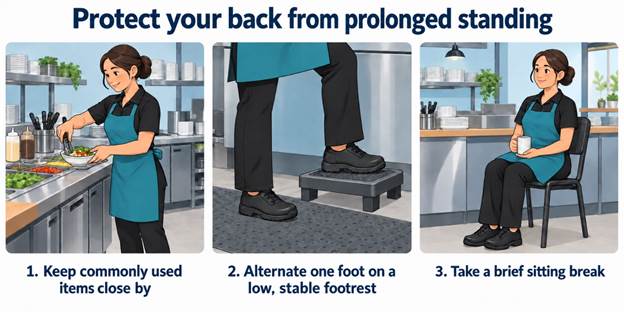
If you are able switch to a different task temporarily, something that requires a different movement pattern, that can help. Take a short, seated break if possible.
-
Add comfortable movement.
If you can get a break, sometimes a comfortable movement like walking or light stretching can make a big difference.
-
Adjust the work area.
If you are standing to perform a specific task for work or otherwise, be deliberate about what you can control. Keep frequently used items in easy reach and arrange things to limit excessive bending or twisting.
-
Consider footwear and flooring.
You may not be able to do anything about the flooring, but something as simple as wearing comfortable shoes can be a big help.
Prolonged standing may be an inevitable part of your life, but there are ways to do it smartly and protect your back. The Mayo Clinic recommends alternating feet, maintaining good posture, and even placing a foot on “a low footstool to take some of the load off the lower back”2.
When Should You Get Back Pain Checked?
Back pain is extremely common, and in most cases should resolve itself without medical intervention. Of course, it’s also something that shouldn’t be taken too lightly and it’s often better to err on the side of caution. You should consider a professional assessment in some cases, including:
- If pain repeatedly interferes with work, cooking, shopping, or other activities.
- If your standing tolerance is getting shorter.
- If symptoms persist for several weeks or are worsening.
- If pain travels into your leg or comes with tingling or numbness.
In some rare circumstances, urgent medical care is recommended. This is especially true if the back pain follows a traumatic event like a fall or a car accident.
NOTE: The American Association of Neurological Surgeons also recommends urgent care if the back pain is accompanied by other symptoms like difficulty urinating or loss of bladder or bowel control, numbness around the groin, genitals, anus, or buttocks, or rapidly worsening leg weakness, especially in both legs3.
Take the Next Step Toward More Comfortable Standing
If you regularly experience back pain while standing, you can give it your attention without assuming any serious damage or underlying injury. In most cases, following the simple suggestions above can go a long way toward helping you stand more comfortably.
If you find that the back is interfering with your work or persisting longer than it should, a good first option is to contact a local physical therapist. A skilled PT can assess your symptoms, your movements, your strength, and any relevant activities to pinpoint the exact cause of your pain and develop a personalized treatment plan to help you overcome it. Physical therapy is a safe and effective treatment option that often helps patients avoid the risks of surgery and pain medication.
Sources
- NIAMS. “Back Pain.” National Institute of Arthritis and Musculoskeletal and Skin Diseases, 23 Apr. 2019, https://www.niams.nih.gov/health-topics/back-pain.
- Mayo Clinic. “Back Pain.” Mayo Clinic, Mayo Clinic, 2018, https://www.mayoclinic.org/diseases-conditions/back-pain/symptoms-causes/syc-20369906.
- Wiseman, Diana. “Cauda Equina Syndrome.” American Association of Neurological Surgeons, 5 Apr. 2024, https://www.aans.org/patients/conditions-treatments/cauda-equina-syndrome/.