

Knee Buckling: What Causes Your Knee to Give Out?
Our knees are some of our hardest working joints. Standing, sitting, walking, running, jumping, and so much more depend on our knees being strong and mobile. It’s easy to take them for granted. That is, it’s easy to take them for granted until one unexpectedly gives way and you’re suddenly struggling to keep your balance.
Knee buckling is something that many people will experience at some point in their lives. It can be a harrowing experience. You may catch yourself before you fall, but realizing that this once reliable body part can suddenly fail without warning can damage your confidence and leave you wondering if you can trust your knees at all.
What Does It Mean When Your Knee Buckles?
There are many potential causes of knee buckling. Some are more significant than others. Before digging into the details, let’s first establish what exactly is meant by “knee buckling”. When a person refers to knee buckling, they are typically referring to:
- a sudden loss of support at the knee while bearing weight.
- a feeling like the knee is collapsing, slipping, shifting, or briefly losing strength.
- a sensation accompanied by pain in some cases; other times no pain at all.
- something that can happen while walking, climbing stairs, turning, or standing up.
Knee buckling typically does not refer to occasional sensations of instability that are not accompanied by an actual buckling.
It’s also important to keep in mind that there is a distinction between true mechanical instability and a knee that temporarily gives way because of pain or impaired muscle control. In either case, whether the knee buckles or just gives a person a sense of instability, research suggests that knee instability can have a serious impact on a person’s balance confidence and fear of falling, ultimately contributing to a less active lifestyle1.
What Causes a Knee to Give Out?
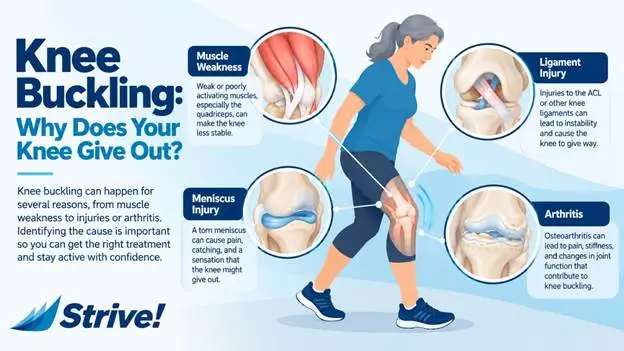
As mentioned above, the knee is an extremely functional and useful body part, and as such it is composed of many parts and systems working together. There are many possible reasons for instability, and buckling should always be seen as a symptom rather than a diagnosis. That said, there are some general causes of the knee buckling that people experience, including:
-
Weakness or Poor Muscle Control
The quadriceps muscles at the front of the thigh play an important role in controlling and supporting the knee. When these muscles are weak or aren't activating effectively, the knee may feel less stable during weight-bearing activities. In fact, the inverse is also true: knee injury or disease can also lead to weakness in the quadriceps2.
-
Ligament Injuries
Some very important ligaments like the anterior cruciate ligament (ACL) help stabilize the knee and control certain movements. ACL injuries (and injuries to other ligaments like the MCL and LCL) can contribute to knee instability and may cause buckling. While knee instability is absolutely not automatic evidence of a ligament injury, the American Academy of Orthopaedic Surgeons does cite knee instability and giving way as symptoms of a potential ligament tear3.
-
Meniscus Injuries
The menisci are two pieces of fibrocartilage that help distribute forces and contribute to knee stability.Meniscus injuries often occur during twisting movements, but degenerative tears can also develop over time. Along with knee buckling, meniscus injuries are often accompanied by symptoms like catching or locking sensations, along with a reduced range of motion4.
-
Knee Osteoarthritis
This will seem obvious to anyone suffering from osteoarthritis, but its effect on joint structures can contribute to pain, stiffness, reduced function, and sensations of instability. Often this also leads to reduced balance confidence and an increased risk of falling5.
These are some of the more common causes of knee buckling, but there are many other possibilities, including kneecap stability problems and others. Any of these situations can contribute to potential knee instability or buckling and an increased risk of falling. Often the knee buckling may be accompanied by other symptoms, like pain, but that is not always the case.
Can Your Knee Buckle Without Pain?
In short, yes, a knee can feel unstable or give way without significant pain, depending on the underlying problem. Pain and instability are often related, but distinct symptoms. Some ligament injuries or persistent movement-control problems can cause instability, even when pain is limited or non-existent. In fact, some people experience ACL tears and are able to function normally, without pain, though in most cases the knee will feel unstable and may buckle occasionally6.
In any case, a lack of pain doesn’t necessarily mean there isn’t a problem that requires medical attention. A knee that repeatedly buckles or gives way deserves an evaluation, even if it doesn’t hurt.
When Should You Be Concerned About Knee Buckling?
An instance of knee buckling doesn’t necessarily mean you need medical attention, but it is something to be aware of. Somes signs that indicate a medical evaluation is warranted include:
- Repeated episodes of buckling.
- Instability that interferes with walking or everyday activities.
- Buckling that causes a fall or near-fall.
- Persistent swelling or stiffness.
- Catching, locking, or difficulty fully straightening the knee.
If your knee instability is causing you to lose confidence in your knees and make you fear falling, it’s a good idea to talk to a medical professional about it. The American Academy of Orthopaedic Surgeons’ guide to common knee injuries recommends seeking treatment promptly for symptoms such as severe pain, swelling, loss of movement, and a knee giving way with a popping sensation during injury3.
If you are experiencing knee buckling or a sense of instability that is interfering with your ability to live and work the way you would like to, don’t hesitate to reach out to a medical professional. Contact a local physical therapist to schedule an evaluation. The sooner you start, the closer you will be to having the strong, healthy knees you need to live an active, healthy life.
Sources
- Nguyen, U. S. D. T., et al. “The Impact of Knee Instability With and Without Buckling on Balance Confidence, Fear of Falling and Physical Function: The Multicenter Osteoarthritis Study.” Osteoarthritis and Cartilage, vol. 22, no. 4, Apr. 2014, pp. 527–34, https://doi.org/10.1016/j.joca.2014.01.008.
- Palmieri-Smith, Riann M., et al. “Pain and Effusion and Quadriceps Activation and Strength.” Journal of Athletic Training, vol. 48, no. 2, Mar. 2013, pp. 186–91, https://doi.org/10.4085/1062-6050-48.2.10.
- “Common Knee Injuries - OrthoInfo - AAOS.” Orthoinfo.Org, 2026, www.orthoinfo.org/diseases--conditions/common-knee-injuries/. Accessed 27 Oct. 2026.
- “Meniscus Tears - OrthoInfo - AAOS.” Orthoinfo.Org, 2026, www.orthoinfo.org/diseases--conditions/meniscus-tears/. Accessed 27 Oct. 2026.
- Nevitt, Michael C., et al. “Symptoms of Knee Instability as Risk Factors for Recurrent Falls.” Arthritis Care & Research, vol. 68, no. 8, July 2016, pp. 1089–97, https://doi.org/10.1002/acr.22811.
- National Library of Medicine. “Anterior Cruciate Ligament (ACL) Injury - Aftercare.” MedlinePlus Medical Encyclopedia, https://medlineplus.gov/ency/patientinstructions/000681.htm. Accessed 27 Oct. 2026.
Frequently Asked Questions
Knee buckling while walking can result from muscle weakness, impaired muscle activation, ligament injuries, meniscus problems, arthritis, or kneecap instability. The specific cause may vary depending on the circumstances and accompanying symptoms.
Yes. Knee osteoarthritis can be associated with episodes of instability or buckling. Pain, muscle weakness, and changes in movement control may contribute.
Physical therapy may reduce episodes of buckling when contributing factors such as weakness, impaired coordination, or balance difficulties can be addressed. Results depend on the underlying condition, and some injuries may require additional medical treatment.
No. Although knee instability may become more common with age, recurrent