

5 Signs Your Balance Problems Deserve a Closer Look
Everyone knows what it feels like to lose your balance. We’ve all tripped or stumbled at some point and felt that sudden unsteadiness, even if just for a moment before recovering. Maybe you tripped over a crack in the sidewalk or a lump in the rug. Maybe your kid left their skateboard in the middle of the front sidewalk again. These balance problems are the result of circumstance and luck. Nobody can keep perfect balance through every situation.
Sometimes, though, a person can find this kind of unsteadiness coming on more easily than it used to. It can become so common that people change the way they live. When you lose confidence in your balance and your fear of falling keeps you from activities you used to enjoy, it’s probably worth a closer look.
When Is Losing Your Balance More Than Just a Clumsy Moment?
Occasional missteps happen to people of all ages. Most times they don’t indicate anything other than bad luck or a clumsy moment. It’s when these incidents become more frequent or begin affecting your everyday activities that they become worth investigating. Sometimes this happens gradually, making the change easy to dismiss. That’s why it’s important to recognize early warning signs and address any problems before they impact your confidence and safety.
In short, balance problems deserve closer attention when they happen repeatedly, cause falls or near-falls, interfere with your everyday activities, or come with other symptoms like dizziness or weakness. Some changes in balance are common as we age, but persistent or worsening unsteadiness shouldn’t be automatically dismissed as a normal part of getting older. Balance problems are something that can be evaluated and addressed at any age1.
Because balance depends on coordination between your vision, inner ear, nervous system, muscles, and joints, there are many ways for it to start failing or becoming less reliable. This complexity is one reason why a proper medical evaluation may be your best course of action when your balance becomes a concern. It’s not always obvious where the source of the problem is.
So how do you know when your balance is becoming a cause for concern? Here are 5 of the most common signs that it’s time for a closer look.
1. You're Stumbling or Nearly Falling More Often
This may seem obvious, but it can be surprisingly easy to ignore if you always manage to catch yourself before you fall. It’s easy to just move on with your day without thinking about it until it happens again. The truth is that regular near-falls are an important warning sign even if you manage to catch yourself. A near-fall is when you suddenly become unstable but avoid falling by grabbing a nearby object, taking a corrective step, or getting assistance from someone. Some examples include:
- Catching yourself on furniture when walking through the house.
- Frequently stumbling over small changes in flooring.
- Losing stability when stepping off a curb.
- Suddenly needing to grab a handrail unexpectedly.
Sometimes these incidents increase gradually over time, but it should get your attention if you find it’s happening to you. These incidents can point to problems with your lower body strength, your sensory awareness and foot positioning, or vision or vestibular function.
Of course, a single incident doesn’t suggest an underlying condition, but repeated or increasingly regular episodes are certainly worth looking into. A physical therapist can help to evaluate your gait, your lower body strength, your reaction time, and more to identify and address underlying problems that may be contributing to increased instability.
2. You Feel Unsteady When Walking or Changing Direction
Walking requires continuous, often unconscious adjustments to keep you upright and stable. Any difficulty with these adjustments can become apparent during ordinary activities like walking in different directions. This category includes things like:
- Feeling as though you're drifting or veering to one side.
- Feeling instability when turning around.
- Taking unusually short or cautious steps.
- Feeling less confident on uneven surfaces.
- Needing to slow down significantly when navigating obstacles.
Walking and turning can reveal balance problems because your body has to coordinate muscle activity, sensory information, and postural adjustments while you’re moving. Muscle weakness, reduced joint mobility, sensory changes, vestibular disorders, or neurological conditions can contribute to your body’s ability to make these constant adjustments2.
3. You Experience Dizziness or a Spinning Sensation
Feeling a sense of dizziness or a spinning sensation can easily interfere with your balance. This is a category that covers symptoms that can emerge in a few different ways, including:
- Dizziness: A broad term that may describe lightheadedness, disorientation, or other similar unusual sensations.
- Vertigo: A false sensation of movement, often described as spinning.
- Disequilibrium: A feeling of unsteadiness or impaired balance, particularly while standing or walking.
Pay attention to when these symptoms occur. Are there certain movements that make you feel unsteady? Do you feel lightheaded when you stand too quickly? Do you feel dizzy when you turn your head? This information can help your medical provider identify the true cause and proper treatment plan. In some cases, these symptoms can indicate vestibular (inner ear), neurological, or even cardiovascular problems3.
4. You Rely on Furniture, Walls, or Handrails to Feel Steady
This is another one that can be easy to overlook. You may gradually start to rely on external support to keep your balance or at least your confidence. Small adjustments like this can easily become habits that are just a normal part of your daily life. You may not realize that you’re doing this more and more often.
If you can’t feel confident in your body’s ability to stay upright and stable, this is obviously going to affect the way you live your daily life. This may be a cause for concern if you find yourself more frequently:
- Reaching for furniture when walking across a room.
- Keeping a hand against the wall in a hallway.
- Needing extra support while dressing.
- Avoiding standing on one foot, even briefly.
- Feeling uncomfortable walking in dimly lit environments.
These changes in behavior may indicate a reduction in strength or endurance, impaired balance response, changes in sensations in your feet, vestibular problems, or simply a fear of falling stemming from a previous incident.
5. Fear of Falling Is Changing What You Do
Balance problems deserve attention when they start affecting your independence, confidence, and participation in everyday life. Sometimes the problem isn’t something that happens. Sometimes it’s something you avoid, like:
- Skipping walks because the ground feels uneven.
- Avoiding stairs or unfamiliar environments.
- Giving up gardening or other outdoor activities.
- Becoming reluctant to leave home alone.
- Avoiding exercise because of concerns about falling.
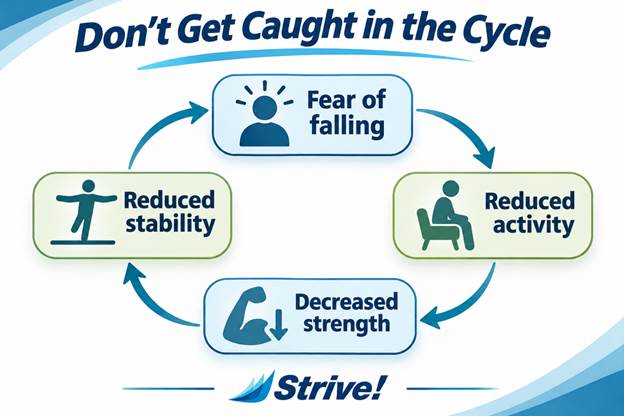
A fear of falling can become a self-reinforcing cycle that leads to more of the same problem. If you start avoiding physical activities, you can lose some of the physical capacity needed to maintain stability, which can lead to even less confidence and more fear, leading to more avoidance and so on. One estimate suggests that as many as one third to one half of older adults restrict or avoid activities that would be beneficial to their health for fear of falling4.
What Should You Do About Balance Problems?
If you find yourself struggling with balance problems or feel like you may be headed in that direction, the best option is to get a professional assessment. A physical therapist can evaluate your balance, your gait, your strength, mobility, and flexibility, and possible vestibular problems. Depending on the results of the evaluation, they may develop a personalized treatment plan to help you address the underlying problems.
If balance problems are making everyday activities more difficult, don’t hesitate to reach out to a qualified physical therapist for an evaluation. The sooner you address the problem, the sooner you will be on your way back to stability and confidence.
Sources
- National Institute on Aging. “Falls and Fractures in Older Adults: Causes and Prevention.” National Institute on Aging, 2022, www.nia.nih.gov/health/falls-and-falls-prevention/falls-and-fractures-older-adults-causes-and-prevention. Accessed 10 Nov. 2026.
- National Institute on Deafness and Other Communication Disorders. “Balance Disorders.” Nidcd, 12 Mar. 2018, www.nidcd.nih.gov/health/balance-disorders. Accessed 10 Nov. 2026.
- Mayo Clinic. “Dizziness - Symptoms and Causes.” Mayo Clinic, 3 Dec. 2022, www.mayoclinic.org/diseases-conditions/dizziness/symptoms-causes/syc-20371787. Accessed 10 Nov. 2026.
- “Overcoming the Fear of Falling.” Harvard Health, 24 Aug. 2020, www.harvardhealth.org/healthy-aging-and-longevity/overcoming-the-fear-of-falling. Accessed 10 Nov. 2026.